Les projets de la CCE réunissent gouvernements, spécialistes et collectivités afin de partager des connaissances, de renforcer les capacités, de mettre à l’essai des solutions évolutives et de consolider la coopération.
Explorez des rapports approfondis, des analyses scientifiques et techniques, des études de cas et des ressources pratiques portant sur les défis environnementaux les plus pressants en Amérique du Nord.
Accueil » Activités » Recours aux réseaux d’observateurs bénévoles pour surveiller les précipitations et les feux de friches
Recours aux réseaux d’observateurs bénévoles pour surveiller les précipitations et les feux de friches
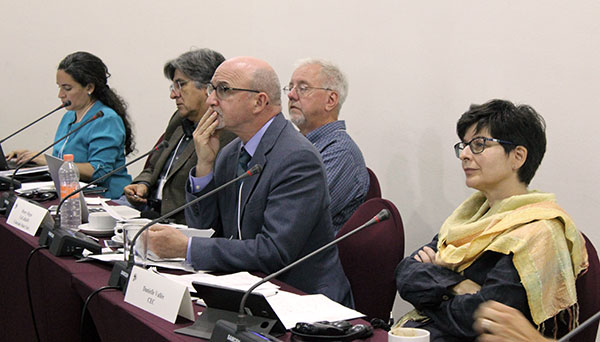
Réunion pour évaluer la possibilité d’établir et d’étendre le Réseau collaboratif communautaire de pluie, de grêle et de neige (CoCoRaHS) et d’autres réseaux citoyens d’observation scientifique pour compléter les capacités nationales et sous-nationales en matière d’observation
Ordre du jour
DAY 1 (Wednesday)
The goal of the project, Using volunteer observer networks to monitor precipitation and wildfires, is to assess information needs and gaps relative to precipitation and wildfires and the feasibility of expanding citizen science and volunteer observation networks across North America, to complement national and sub-national capacities to prepare for and respond to extreme events. The specific objectives of the present meeting, which has been organized in support of this project, are:
To discuss the expansion of the Community Collaborative Rain, Hail and Snow, (CoCoRaHS) network in North America; and
To assess the feasibility of establishing or expanding other networks across the region.
8:45
Registration
9:00
Session 1: Welcome and Introductions; Objectives of the Meeting
Orlando Cabrera, Head, Environmental Quality Unit, Commission for Environmental Cooperation (CEC)
Jorge Zavala Hidalgo, General Coordinator, National Meteorological Service (Servicio Meteorológico Nacional)
9:30
Session 2: Monitoring and prediction of precipitation and wildfires in Mexico:
Capacities, gaps, and needs
Fabián Vázquez Romaña
Observation and Telematics Networks,
National Meteorological Service (Servicio Meteorológico Nacional, SMN) Télécharger la présentation
Fabián Vázquez Romaña
Observation and Telematics Networks,
National Meteorological Service (Servicio Meteorológico Nacional, SMN)
Telma Castro Romero and Michel Grutter de la Mora
Atmospheric Sciences Center (Cientro de Ciencias de la Atmósfera), Universidad Nacional Autónoma de México (UNAM), Red Universitaria de Observatorios Atmosféricos (RUOA) Télécharger la présentation
Telma Castro Romero and Michel Grutter de la Mora
Atmospheric Sciences Center (Cientro de Ciencias de la Atmósfera), Universidad Nacional Autónoma de México (UNAM), Red Universitaria de Observatorios Atmosféricos (RUOA)
César Alberto Robles Gutiérrez
Associate Manager, National Fire Management Center (Centro Nacional de Manejo del Fuego), National Forest Comission (Comisión Nacional Forestal, Conafor) Télécharger la présentation
César Alberto Robles Gutiérrez
Associate Manager, National Fire Management Center (Centro Nacional de Manejo del Fuego), National Forest Comission (Comisión Nacional Forestal, Conafor)
11:00
Break
11:15
Session 3: CoCoRaHS and the added value of a North American network
Henry Reges, National Coordinator; Steve Hilberg, Project Manager; and Matt Spies, Volunteer Coordinator, CoCoRaHS United States
CoCoRaHS overview: Structure, volunteer engagement, coordination, quality control, data/technical needs, and relationships with other networks Télécharger la présentation
Henry Reges, National Coordinator; Steve Hilberg, Project Manager; and Matt Spies, Volunteer Coordinator, CoCoRaHS United States
CoCoRaHS overview: Structure, volunteer engagement, coordination, quality control, data/technical needs, and relationships with other networks
Rick Fleetwood
Manager, Atlantic Climate Centre, Environment and Climate Change Canada (ECCC)
Experience and lessons learned: Canada Télécharger la présentation
Rick Fleetwood
Manager, Atlantic Climate Centre, Environment and Climate Change Canada (ECCC)
Experience and lessons learned: Canada
Odalys Martínez
CoCoRaHS Puerto Rico
Experience and lessons learned: Puerto Ricoo, Télécharger la présentation
Odalys Martínez
CoCoRaHS Puerto Rico
Experience and lessons learned: Puerto Ricoo,
13:00
Lunch
14:00
Session 4: Benefits of collaborating with the CoCoRaHS network
Sarah Ingram
Tribal Capacity and Training Program,
Local Environmental Observers (LEO) Network Télécharger la présentation
Sarah Ingram
Tribal Capacity and Training Program,
Local Environmental Observers (LEO) Network
15:15
Break
15:30
Session 5: Feasibility of expanding the CoCoRaHS network: Factors to consider
Henry Reges
CoCoRaHS United States
CoCoRaHS as a Model: Considerations for a successful volunteer network Télécharger la présentation
Henry Reges
CoCoRaHS United States
CoCoRaHS as a Model: Considerations for a successful volunteer network
Is this the right model? Next steps? – Group discussion
Is this the right model? Next steps? – Group discussion
DAY 2 (Thursday)
8:45
Registration
9:00
Session 1: Re-cap of Day 1 – Key messages and lessons learned
Orlando Cabrera, CEC
9:15
Session 2: Availability and communication of air quality and smoke data and information to protect public health
Introductory comments –Annette Guiseppi-Elie, Associate Director for Exposure Science, National Exposure Research Laboratory, U.S. Environmental Protection Agency (EPA)
9:30
Session 3: Availability and communication of air quality and smoke data and information to protect public health: Mexican and Canadian perspectives
Ramiro Barrios Castrejon
Director, Air Quality Management for Metropolitan Zones,
Environment Commission of the Megalopolis (Comisión Ambiental de la Megalópolis, CAMe) Télécharger la présentation
Ramiro Barrios Castrejon
Director, Air Quality Management for Metropolitan Zones,
Environment Commission of the Megalopolis (Comisión Ambiental de la Megalópolis, CAMe)
Luis Gerardo Ruiz Suarez
General Coordinator, Pollution and Environmental Health Division
National Institute of Ecology and Climate Change (Instituto Nacional de Ecología y Cambio Climático, INECC)
Luis Gerardo Ruiz Suarez
General Coordinator, Pollution and Environmental Health Division
National Institute of Ecology and Climate Change (Instituto Nacional de Ecología y Cambio Climático, INECC)
11:00
Break
11:15
Session 3 (cont’d): Availability and communication of air quality and smoke data and information to protect public health: Mexican and Canadian perspectives
Sarah Henderson
Senior Scientist, B.C. CDC
British Columbia Centers for Disease Control (CDC) Télécharger la présentation
Sarah Henderson
Senior Scientist, B.C. CDC
British Columbia Centers for Disease Control (CDC)
11:45
Session 4: Existing tools for communicating air quality, smoke/fire, and public health information
Olivia Rivera
Directora, SIMAT – Secretaria de Medio Ambiente (SEDEMA),
Ciudad de México
AIRE application Télécharger la présentation
Olivia Rivera
Directora, SIMAT – Secretaria de Medio Ambiente (SEDEMA),
Ciudad de México
AIRE application
Céline Audette
Senior Policy Analyst, Air Quality & Health Forecast Services, Environment and Climate Change Canada (ECCC)
Firework Wildfire Smoke Prediction System Télécharger la présentation
Céline Audette
Senior Policy Analyst, Air Quality & Health Forecast Services, Environment and Climate Change Canada (ECCC)
Firework Wildfire Smoke Prediction System
13:00
Lunch
14:00
Session 4 (cont’d): Existing tools for communicating air quality, smoke/fire, and public health information
Ana Rappold
Principal Investigator, Smoke Sense, U.S. EPA
Smoke Sense project: Overview and findings Télécharger la présentation
Ana Rappold
Principal Investigator, Smoke Sense, U.S. EPA
Smoke Sense project: Overview and findings
14:30
Session 5: Perspectives of volunteer observation networks in North America
Evaristo Rojas
Director, Data Sciences, and Ana Marichal, GECI, Mexico
Island Ecology and Conservation Group (Grupo de Ecología y Conservación de Islas, GECI) Télécharger la présentation
Evaristo Rojas
Director, Data Sciences, and Ana Marichal, GECI, Mexico
Island Ecology and Conservation Group (Grupo de Ecología y Conservación de Islas, GECI)
Sarah Ingram
Tribal Capacity and Training Program, LEO Network
Local Environmental Observer (LEO) Network, United States Télécharger la présentation
Sarah Ingram
Tribal Capacity and Training Program, LEO Network
Local Environmental Observer (LEO) Network, United States
15:15
Session 6: Expanding Smoke Sense and other tools or networks: Factors to consider