The Commission for Environmental Cooperation (CEC) held the Trinational Trade and Enforcement Training Workshop to Support the Legal and Sustainable Trade in Turtles and Tortoises in Miami, Florida, United States, from 24 to 26 October 2018. The development of this workshop was identified as a priority action in the CEC Action Plan for North America: Sustainable Trade in Turtles and Tortoises (CEC 2017). The workshop objectives were extensive and sought to understand the ecology and life-history traits of turtles, recognize the challenges presented by trade (both pet and meat trade), identify research and management needs to help achieve sustainable trade and maintain viability of wild populations in North America, develop or revise policy for achieving turtle conservation, and revise a priority-species list.
The Regional Workshop on the Evaluation of Capacities to Identify Woods in the Trade of CITES-listed Priority Timber Species was conducted as part of the Supporting Sustainable Trade of CITES Species project, under the Commission for Environmental Cooperation (CEC) 2017–2018 Operational Plan. The workshop took place in the city of Chetumal, Quintana Roo, Mexico, on 6–8 November 2018. It brought together policymakers, environmental law enforcement officials, and the authorities responsible for enforcing the Convention on International Trade in Endangered Species of Wild Fauna and Flora (CITES), along with researchers, producers, nongovernmental organizations, and industry representatives.
As part of the Commission for Environmental Cooperation’s (CEC) project; Science for Monarch Butterfly and Pollinator Conservation, this meeting convened government experts, researchers and key stakeholders from Canada, Mexico and the United States to share novel research and scientific findings on the monarch butterfly, establish further collaborations for data sharing, and identify trinational research and […]
CEC’s work on hazardous waste management spanned 18 years and included the following initiatives: Training and consolidating information-sharing among customs agencies regarding the illegal trade in environmentally regulated hazardous waste materials; Creating a series of comprehensive documents detailing the laws, regulations, trade patterns and enforcement experiences applicable to particular sectors; Developing technical guidelines and compiling […]
The North American Pollutant Release and Transfer Register (NAPRTR) Initiative originates from a commitment of Canada, Mexico and the United States under the North American Agreement on Environmental Cooperation (NAAEC) to enhance the quality and comparability of PRTR data across the region, through improvements in methodologies for data gathering and management, electronic communications, and analyses, […]
Because our environment does not end at the border, the CEC has developed over the last 22 years a unique framework that harmonizes geographic information in a seamless manner across North America’s political boundaries. Its North American Environmental Atlas aims at better monitoring environmental trends and land-cover changes in the region.
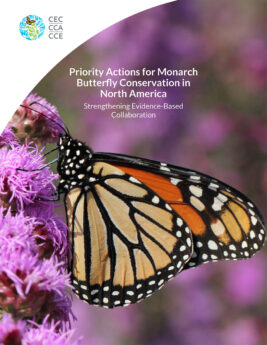
Since 1996, the Commission for Environmental Cooperation has been actively involved in the conservation of the monarch butterfly (Danaus plexippus), a symbol of trinational environmental cooperation between Canada, Mexico, and the United States. Although interrupted for a few years, CEC efforts to conserve the species intensified after population declines were recorded at overwintering sites in […]
The North American grasslands are the only shared, contiguous terrestrial ecoregion extending across the three countries. Between July 2011 and June 2015, the Commission for Environmental Cooperation (CEC) invested C$990,000 in two 2-year projects focusing on grasslands conservation. The CEC conducted an assessment process to evaluate the impacts of this investment at two and four […]
Toks, a 100% Mexican restaurant chain with more than 200 restaurants throughout the country, has undertaken various initiatives to reduce food loss and waste (FLW), including offering some of its dishes in different portion sizes.
This guide is intended to guide original equipment manufacturers (OEM) and supplier organizations in establishing and institutionalizing the organizational structures and management systems needed to effectively and efficiently achieve their desired energy performance goals and objectives. Central to this approach is the recognition that the ISO 50001 Energy Management System is internationally recognized as the […]
This guide was developed as part of the Commission for Environmental Cooperation (CEC) Operational Plan 2017-2018 and its Measuring and Mitigating Food Loss and Waste project. The goal of the project is to improve measurement of food loss and waste (FLW) across the North American supply chain and to calculate its environmental and socioeconomic impacts. […]
Food loss and waste (FLW) is an important issue in Canada, Mexico, and the United States, where almost 170 million tonnes of the food produced for human consumption is estimated to be wasted across the supply chain (CEC 2017b), while food security and resource efficiency are considered top priorities of the national social, environmental and development policies.