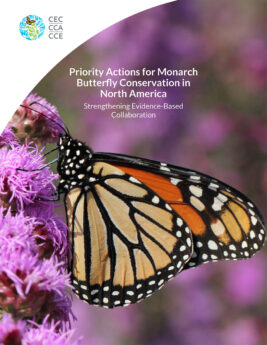
As part of the Commission for Environmental Cooperation’s project Monarch Butterfly Flyway: Communication, Participatory Conservation, and Education Programs throughout the Migratory Route,a workshop entitled Monitoring Monarch Butterflies and their Habitat across North America was held in Toluca, Mexico, on 4–5 March 2017.
The North American Marine Protected Area Rapid Vulnerability Assessment Tool was created to help marine protected area managers evaluate the implications of climate change for the habitats of their sites. This tool has three parts (a user guide, a set of blank worksheets, and a booklet containing sample completed worksheets) that are available as downloadable […]
The North American Marine Protected Area Rapid Vulnerability Assessment Tool was created to help marine protected area managers evaluate the implications of climate change for the habitats of their sites. This tool has three parts (a user guide, a set of blank worksheets, and a booklet containing sample completed worksheets) that are available as downloadable […]
The North American Marine Protected Area Rapid Vulnerability Assessment Tool was created to help marine protected area managers evaluate the implications of climate change for the habitats of their sites. This tool has three parts (a user guide, a set of blank worksheets, and a booklet containing sample completed worksheets) that are available as downloadable […]
The inventory of key sites for Semipalmated Sandpiper and Red Knot was compiled from published information sources and publicly available databases. Once an initial inventory was compiled, it was sent for review by experts on the relevant species. Sites were then prioritized using the three levels of biological importance used by WHSRN (1, 10 and 30% of the biogeographic population). Detailed information for each site was compiled in a standard site matrix. Information on threats was gathered for all sites where a standardized threat assessment process had been undertaken. Finally, for those sites holding more than 10% of a population, local conservation leads and shorebird experts were contacted to help explore if local communities might be interested in participating in a North American network of sites to conserve shared shorebirds. Priority was given to discussing this with sites that are not already part of WHSRN.
Coastal marine ecosystems are recognized as highly productive systems, but their potential to store and sequester organic carbon, known as blue carbon, has largely been overlooked on the Pacific Coast of North America (Nellemann et al. 2009; McLeod et al. 2011). Vegetated coastal ecosystems, such as mangroves, salt marshes, seagrass meadows, and kelp forests are […]
Recent research has focused on the high carbon accumulation rates of coastal ecosystems, such as those of mangroves, seagrasses, and salt marshes, as a means of sequestering (blue) carbon for climate mitigation purposes. Material from dead plants and animals in salt marshes accumulates over time in low-oxygen conditions, limiting the CO2 emissions from the normal […]
Eelgrass (Zostera marina) is a seagrass and the primary rooted marine plant found in the coastal waters of the Pacific Northwest (which, for this study, will be taken as comprising the US states of Oregon and Washington, and the Canadian province of British Columbia). Unlike algae, it is a rooted plant and it traps, accumulates […]
Carbon that is stored in coastal and marine ecosystems is referred to as ‘blue carbon’. Blue carbon stocks (or carbon storage) have only recently been acknowledged as globally significant (Fourqurean et al. 2012). Meta-analyses reveal that blue carbon habitats, in particular mangroves, seagrass meadows and salt marshes, play a disproportionally large role in carbon sequestration […]
As part of a project of the Commission for Environmental Cooperation, this Guide outlines the steps required to create or enhance a syndromic surveillance system to monitor extreme heat events, and highlights the experiences of three participating pilot communities from Canada, Mexico and United States. A successful syndromic surveillance system uses pre-diagnostic data sources to monitor for early signs of health effects in order to enable early public health response.
This document is one of a set of five action plans that were prepared as part of a project by the Commission for Environmental Cooperation (CEC) to promote legal, sustainable and traceable trade in selected North American species that are listed in Appendix II of the Convention on International Trade in Endangered Species of Wild Fauna and Flora (CITES). The five action plans were produced under the guidance of the CITES Authorities of Canada, Mexico and the United States.
This document is one of a set of five action plans that were prepared as part of a project by the Commission for Environmental Cooperation (CEC) to promote legal, sustainable and traceable trade in selected North American species that are listed in Appendix II of the Convention on International Trade in Endangered Species of Wild Fauna and Flora (CITES). The five action plans were produced under the guidance of the CITES Authorities of Canada, Mexico and the United States.