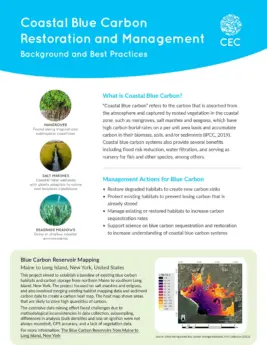
In 2024, the Commission for Environmental Cooperation (CEC) convened a series of workshops on blue carbon as part of its 2021–2025 project “Enhancing Co-Benefits of Marine Protected Areas.” The workshops brought together experts to exchange knowledge, best practices, case studies and opportunities related to blue carbon ecosystems within Marine Protected Areas (MPAs) and other effective […]
The Central Grasslands of North America provide vital habitat and ecosystem services, yet continue to decline despite ongoing conservation efforts. This integration plan addresses the gap between social science research and its application in grassland conservation delivery. Drawing on three complementary efforts (a literature review of conservation social science, a synthesis of surveys of ranchers, […]
This report presents the results of a survey of ranchers and livestock owners across the Chihuahuan Desert region of northern Mexico, to understand their perspectives, experiences and practices related to livestock production and grassland conservation. A structured questionnaire was distributed digitally and in print to collect both quantitative and qualitative data from 172 participants, mostly […]
Many remote and Indigenous communities across North America face unique challenges because of their geographic isolation, harsh climates and limited infrastructure. As a result, they often depend on costly and environmentally damaging diesel generators for electricity. This report analyzes nine case studies from Canada, Mexico and the United States that highlight successful renewable energy transition […]
The Central Grasslands of North America support critical biodiversity and human communities, yet continue to decline due to cropland conversion, climate change and other threats. This literature review synthesizes existing conservation social science research to better understand how grassland management decisions are made and how this knowledge can be more effectively integrated into conservation delivery. […]
Flood-risk management is a major concern for coastal communities, particularly when considering sea-level rise caused by climate change. Nature-based solutions (NBS) have the potential to meet many flood-risk management objectives while also providing social, environmental, and economic co-benefits. This series of guidance documents and accompanying briefing notes was designed to support the uptake of NBS […]
Flood-risk management is a major concern for coastal communities, particularly when considering sea-level rise caused by climate change. Nature-based solutions (NBS) have the potential to meet many flood-risk management objectives while also providing social, environmental, and economic co-benefits. This series of guidance documents and accompanying briefing notes was designed to support the uptake of NBS […]
Flood-risk management is a major concern for coastal communities, particularly when considering sea-level rise caused by climate change. Nature-based solutions (NBS) have the potential to meet many flood-risk management objectives while also providing social, environmental, and economic co-benefits. This series of guidance documents and accompanying briefing notes was designed to support the uptake of NBS […]
This report documents a collaborative effort to engage Indigenous communities in northern Mexico within the framework of the Central Grasslands Roadmap. Through visits, dialogues and knowledge exchanges in 2023 and 2024, members of the Indigenous Kinship Circle (IKC), community leaders and local partners listened to community perspectives on cultural continuity, climate change, food security and […]
Grassland loss is one of the most pressing conservation challenges in North America, yet the ability to track this change is complicated by the diversity of existing monitoring systems. This report reviews 33 grassland inventories across Canada, Mexico and the United States, drawing on a literature review and expert workshops held in 2023 and 2024. […]
The Central Grasslands are among the largest remaining intact grasslands in North America, supporting both biodiversity and agricultural production. To ensure that the perspectives of ranchers, producers and landowners are included in conservation planning, surveys were conducted in Canada, Mexico and the United States in 2021 and 2022. This report summarizes and compares responses across […]
Grasslands are among the most threatened ecosystems worldwide, and their loss poses major challenges for biodiversity, climate resilience and sustainable food production. To better understand producer perspectives, a 2022 survey of 104 Canadian cattle producers explored views on grassland loss, enrollment in conservation programs and priorities for monitoring ecosystem health. Results show that most producers […]