In North America, we share vital natural resources, including air, oceans and rivers, mountains and forests. Together, these natural resources are the basis of a rich network of ecosystems, which sustain our livelihoods and well-being. If they are to continue being a source of future life and prosperity, these resources must be protected. This stewardship […]
North America is a continent rich in diversity. Climatic types range from the polar arctic to tropical forests. Topographically, the continent contains a valley with the lowest elevation on earth and also extensive chains of tall mountains. It is blessed with rich natural resources as well as an unmatched variety of scenic natural beauty. Possessed […]
This study of the environmental potential and performance of the institutions created by the North American Free Trade Agreement (NAFTA) represents a substantive contribution to Phase II of the Commission for Environmental Cooperation’s NAFTA Effects Project.
This report synthesizes the current state of knowledge with respect to ozone transport in the eastern United States and Canada.
The development of environmental education and training programs in North America is a priority for the Commission for Environmental Cooperation (CEC) and is an important part of its overall objective to encourage regional cooperation and public participation in conservation and environmental protection in North America.
Providing the public with information on pollutant sources and risks is recognized by all three countries of North America as an important tool for protecting human health and the environment. In 1995, the CEC’s Council of Ministers decided to create a North American Pollutant Release Inventory to help the public better understand pollutant releases in […]
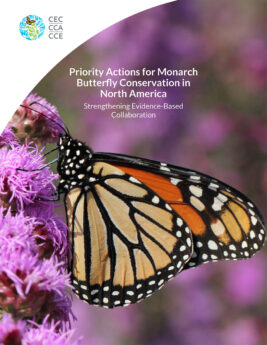
This guide will aid in recognizing eggs and distinguishing larval (caterpillar) instars of monarch butterflies (Danaus plexippus) in the field.
The RAP establishes a framework for environmentally sound management and control of polychlorinated biphenyls (PCBs) in North America. PCBs are a class of persistent, toxic chemical compounds that bioaccumulate in the environment and are recognized as potential carcinogens.
The Commission for Environmental Cooperation’s (CEC) report, Assessing Latin American Markets for North American Environmental Goods and Services features such critical information as what makes multinational or North American partnerships successful, where markets are expanding, and where Mexico has been successful in developing clean technologies and adapting proven technologies from the US and Canada for […]
As environmental protection becomes increasingly more sophisticated, companies and governments in North America are moving away from traditional “end-of-pipe” pollution control methods in favor of changes to production that eliminate or reduce waste and pollution from the outset.
This paper, the first of two documents on pollutant releases and transfers in North America, looks at regional programs in North America including the U.S. Toxics Release Inventory, Canada’s National Pollutants Release Inventory and a new project in Mexico, the Registry of Emissions and Pollutant Transfer.