Community-led Food Forest Development for Climate Resilience in Boston
@ Boston Food Forest Coalition
Background
Boston Food Forest Coalition (BFFC) was founded in 2015 to address Boston's painful and intentional history of systemic racism in its neighborhood development policies. These policies have created drastic inequality in access to green space and magnified the impact of climate change on majority of BIPOC neighborhoods. In 2021, the City of Boston reported that communities of color that had been subjected to redlining in the past had 16% less parkland and 7% less tree cover than the citywide median. These neighborhoods were 3.3º Fahrenheit (1.8º Celsius) hotter during the day and 1.9º F (1º C) hotter at night, making residents more vulnerable to urban heat waves that are becoming increasingly common with climate change.
Goals
BFFC will use funding from the EJ4 Climate program to underwrite operating costs associated with the launch of three new food forests over the next twelve months, and integrated community education and engagement opportunities.
Main activities
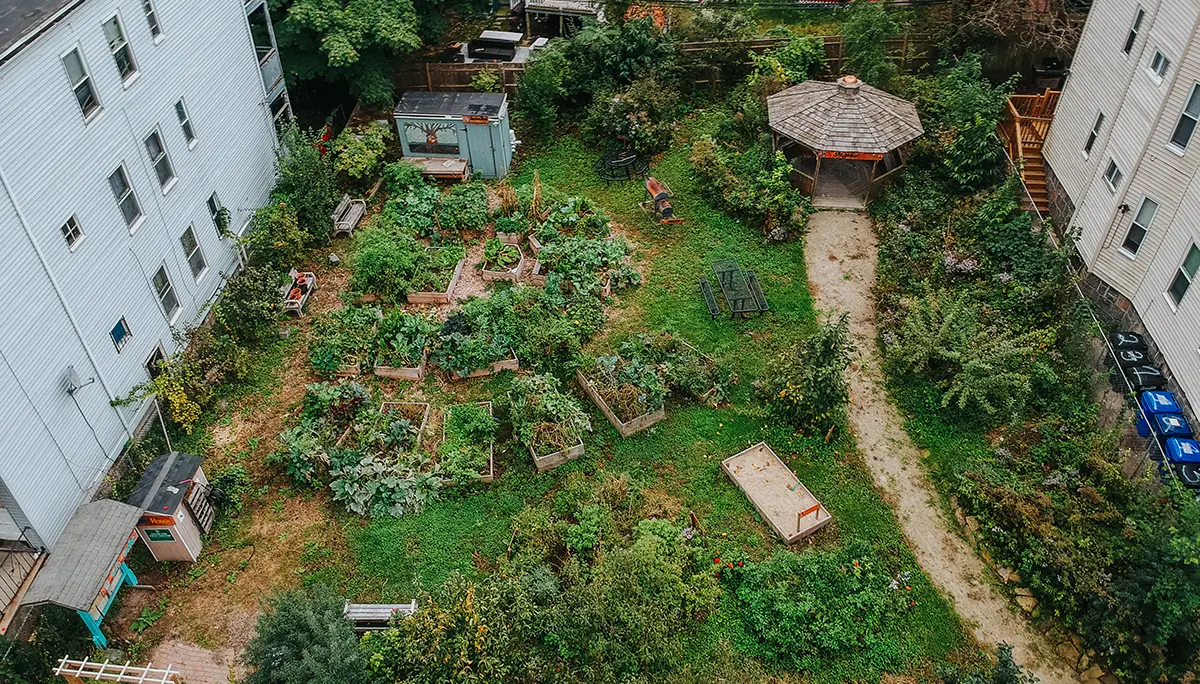
In conversation with the community, we develop a unique 3-dimensional design for each food forest site, including tree canopy for needed shade, fruit and nut shrubs for food, perennial plants, inviting structures (pathways, benches, gazebos), and welcoming signage and artwork. In partnership with the City of Boston, BFFC then acquires these vacant land parcels, manages their development, trains and supports the neighbors to steward the land, and places them into community control to remain protected in the BFFC community land trust in perpetuity.
Expected outcomes
This grant will help provide the seed funding needed for the launch of three new food forest sites in Boston neighborhoods with increased vulnerability to the impacts of climate change. Once built, our parks will become permanent vibrant public spaces with positive community benefits that will extend for generations. BFFC will continue to engage and educate neighbors to serve on stewardship teams overseeing the ongoing maintenance and management of the sites. Our food forests are inherently designed to be sustainable in the long term using a style of land management known as permaculture, which emphasizes the use of perennials (plants that return year after year) to create natural ecosystems that operate in a self-sufficient way.