


Adaptation and Climate Change Resilience Program Based on Ecosystems and Milpas in Cardonal, Hidalgo
@ Sebastián Chávez Mendoza
Background
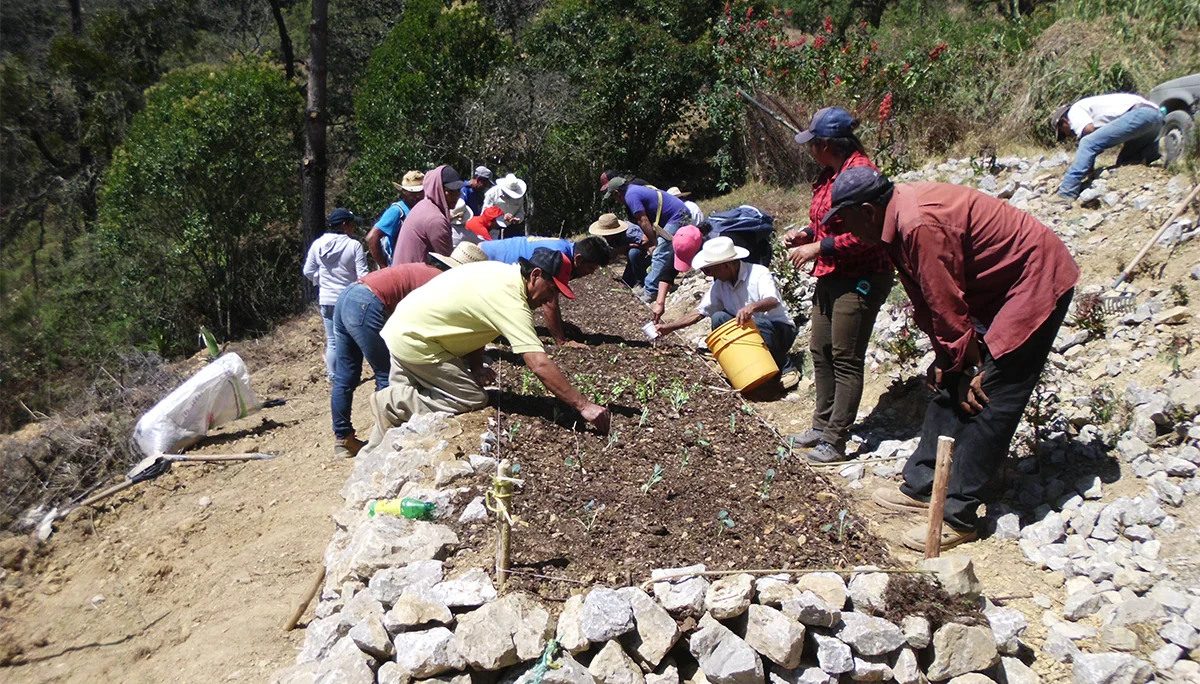
In the municipality of Cardonal, milpa fields are used to grow corn, beans, squash and chili peppers in plots of land called melgas (melgas are small plots of cultivated land, generally rectangular, marked off by dams or ditches for irrigation and drainage) that are surrounded by plants like the maguey, nopal, mesquite, huisache, tepozán, oak trees, junipers, thorny bushes and some fruit trees. Production is rainfed and for self-consumption among families.
There has been a constant loss of moisture in the soil and agroecosystems due to cultivation and recent pests. This is compounded by variations in rainfall patterns, an increase in soil dryness and a loss of productive capacity. These phenomena have created great uncertainty and difficult conditions for farming families; consequently, these families have left the countryside, especially youth. At the very least, they are facing a decline in work.
Owing to a lack of mechanisms for monitoring and mitigating climate change, the situation is worsening.
Goals
- 450 trained families, along with their respective plots of land with the implemented adaptation model.
- 12 community groups, with coordinated work.
- 12 workshops on the climate change adaptation model.
- 12 community brigades for data collection.
- Two integrated production models and value chains.
- Microregional agreements with respect to joint actions on adapting to climate change.
Main activities
- Participation in community assemblies to report on the project.
- Creation of group structures, liaisons and minimum agreements.
- Climate change training and demonstration of results from planned land-plotting work.
- Community brigades to collect plants resistant to climate change and suitable as cover crops.
- Analysis workshop and proposals regarding an integrated production model.
- Brigades for implementing integrated production models.
- Reflection workshop on plants resilient to climate change.
- Monitoring, follow-up and support meetings.
- Microregional forum with key actors and social figures, to strengthen the program.
Expected outcomes
- Families have plans for diversified plots of land and can manage climate change adaptation; ongoing intercommunity collaborative work.
- Adaptive land management, cover crops and staggered production.
- Value chains with storage mechanisms and internal control systems.
- Established partnership with actors and key figures to analyze and implement territorial management and adaptation to climate change.
- Adopted agreements for territorial management.
- Key social figures involved in implementing microregional agreements.