The Regional Workshop on the Evaluation of Capacities to Identify Woods in the Trade of CITES-listed Priority Timber Species was conducted as part of the Supporting Sustainable Trade of CITES Species project, under the Commission for Environmental Cooperation (CEC) 2017–2018 Operational Plan. The workshop took place in the city of Chetumal, Quintana Roo, Mexico, on 6–8 November 2018. It brought together policymakers, environmental law enforcement officials, and the authorities responsible for enforcing the Convention on International Trade in Endangered Species of Wild Fauna and Flora (CITES), along with researchers, producers, nongovernmental organizations, and industry representatives.
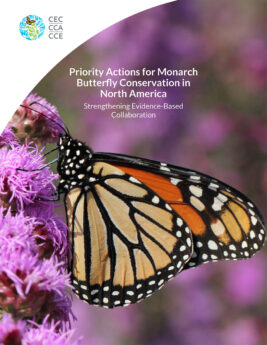
As part of the Commission for Environmental Cooperation’s (CEC) project; Science for Monarch Butterfly and Pollinator Conservation, this meeting convened government experts, researchers and key stakeholders from Canada, Mexico and the United States to share novel research and scientific findings on the monarch butterfly, establish further collaborations for data sharing, and identify trinational research and […]
Because our environment does not end at the border, the CEC has developed over the last 22 years a unique framework that harmonizes geographic information in a seamless manner across North America’s political boundaries. Its North American Environmental Atlas aims at better monitoring environmental trends and land-cover changes in the region.
Since 1996, the Commission for Environmental Cooperation has been actively involved in the conservation of the monarch butterfly (Danaus plexippus), a symbol of trinational environmental cooperation between Canada, Mexico, and the United States. Although interrupted for a few years, CEC efforts to conserve the species intensified after population declines were recorded at overwintering sites in […]
The North American grasslands are the only shared, contiguous terrestrial ecoregion extending across the three countries. Between July 2011 and June 2015, the Commission for Environmental Cooperation (CEC) invested C$990,000 in two 2-year projects focusing on grasslands conservation. The CEC conducted an assessment process to evaluate the impacts of this investment at two and four […]
Under its 2015–2016 project, Using Ecosystem Function and Traditional Ecological Knowledge Together to Build Resilience and Adapt to Climate Change in North America, the CEC facilitated the exchange of tools, methodologies and assessments developed in Canada, Mexico and the United States to support the development of ecosystem-based, local adaptation in communities vulnerable to the effects […]
As part of the Commission for Environmental Cooperation’s project Monarch Butterfly Flyway: Communication, Participatory Conservation, and Education Programs throughout the Migratory Route,a workshop entitled Monitoring Monarch Butterflies and their Habitat across North America was held in Toluca, Mexico, on 4–5 March 2017.
The North American Marine Protected Area Rapid Vulnerability Assessment Tool was created to help marine protected area managers evaluate the implications of climate change for the habitats of their sites. This tool has three parts (a user guide, a set of blank worksheets, and a booklet containing sample completed worksheets) that are available as downloadable […]
The North American Marine Protected Area Rapid Vulnerability Assessment Tool was created to help marine protected area managers evaluate the implications of climate change for the habitats of their sites. This tool has three parts (a user guide, a set of blank worksheets, and a booklet containing sample completed worksheets) that are available as downloadable […]
The North American Marine Protected Area Rapid Vulnerability Assessment Tool was created to help marine protected area managers evaluate the implications of climate change for the habitats of their sites. This tool has three parts (a user guide, a set of blank worksheets, and a booklet containing sample completed worksheets) that are available as downloadable […]
The inventory of key sites for Semipalmated Sandpiper and Red Knot was compiled from published information sources and publicly available databases. Once an initial inventory was compiled, it was sent for review by experts on the relevant species. Sites were then prioritized using the three levels of biological importance used by WHSRN (1, 10 and 30% of the biogeographic population). Detailed information for each site was compiled in a standard site matrix. Information on threats was gathered for all sites where a standardized threat assessment process had been undertaken. Finally, for those sites holding more than 10% of a population, local conservation leads and shorebird experts were contacted to help explore if local communities might be interested in participating in a North American network of sites to conserve shared shorebirds. Priority was given to discussing this with sites that are not already part of WHSRN.
Coastal marine ecosystems are recognized as highly productive systems, but their potential to store and sequester organic carbon, known as blue carbon, has largely been overlooked on the Pacific Coast of North America (Nellemann et al. 2009; McLeod et al. 2011). Vegetated coastal ecosystems, such as mangroves, salt marshes, seagrass meadows, and kelp forests are […]