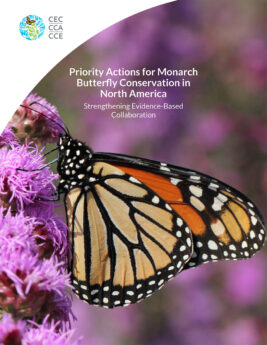
This plan provides an updated account of the species and its current situation, identifies the main risk factors affecting it and its habitat throughout the flyway, and summarizes the current conservation actions taken in each country. Against this background, it offers a list of key trinational collaborative conservation actions, priorities and targets to be considered for adoption by the three countries.
Using the case of the Mexican portion of the Mesoamerican Reef, this paper presents an analysis of the relationship between trade, tourism development and its impacts on the environment using the framework of the Organization of Economic Cooperation Development for trade-related environmental effects.
The purpose of the study is to determine how NAFTA influences the Mexican tourism sector and its effects on the environment.
A report of activities carried out in support of SPLASH under the North American Conservation Action Plan (NACAP) for the Humpback Whale
This NACAP is intended to provide a trinational outlook on the species. It gives an updated account of the species and its current situation, identifies the main risk factors causing the species to suffer an unsustainable level of mortality, and summarizes the current management and actions taken in each country, as well as public and […]
This NACAP, developed for the ferruginous hawk (Buteo regalis), resulted from a trinational workshop hosted by the CEC in Calgary in June 2004 and benefited from the in-depth review of an extensive list of wildlife experts from diverse backgrounds from Canada, Mexico and the United States. Furthermore, the content of this NACAP has been shared […]
This NACAP, developed for the western burrowing owl (, hereafter “burrowing owl”), resulted from a trinational workshop hosted by the CEC in Calgary in July 2004 and benefited from the in-depth review of an extensive list of wildlife experts from diverse backgrounds from Canada, Mexico and the United States. Furthermore, the content of this NACAP […]
This NACAP, developed for the pink-footed shearwater (), resulted from a trinational workshop hosted by the CEC in San Francisco, California, in March 2004, and benefited from the in-depth review of an extensive list of wildlife experts from diverse backgrounds from Canada, Mexico and the United States. Furthermore, the content of this NACAP has been […]
This NACAP, developed for the humpback whale (), resulted from a trinational workshop hosted by the CEC in San Francisco, California in March 2004 and benefited from the in-depth review of an extensive list of wildlife experts from diverse backgrounds from Canada, Mexico and the United States. Furthermore, the content of this NACAP has been […]
This NACAP, developed for the Pacific leatherback sea turtle (, hereafter “leatherback turtle”), resulted from a trinational workshop hosted by the CEC in San Francisco, California, in March 2004 and benefited from the in-depth review of an extensive list of wildlife experts from diverse backgrounds from Canada, Mexico and the United States. Furthermore, the content […]
This NACAP, developed for the black-tailed prairie dog (Cynomys ludovicianus), resulted from a trinational workshop hosted by the CEC in Calgary in July 2004 and benefited from the in-depth review of an extensive list of wildlife experts from diverse backgrounds from Canada, Mexico and the United States. Furthermore, the content of this NACAP has been […]
In North America, we share a rich environmental heritage that includes air, oceans and rivers, mountains and forests. Together, these elements form the basis of a complex network of ecosystems that sustains our livelihoods and well-being. If these ecosystems are to continue to be a source of life and prosperity, they must be protected. Doing so is a responsibility shared by Canada, Mexico and the United States.